
NILESH PANDEY
PhD Student
"Finding the faints and the brights"
ABOUT ME
Hi, I’m Nilesh.
I’m an aspiring astrophysicist from Uttarakhand with a deep interest in science and making it exciting for students. One of my long-term goals is to introduce hands-on astronomy education in schools. This vision is already taking shape in my hometown, where Uttarakhand’s first planetarium is being set up at DIET Didihat, where my father serves as head. Outside academics, I enjoy playing instruments such as guitar, tabla, and piano. Video games are my go-to for leisure (especially classics like Age of Empires). I’m also passionate about sports and have represented my district three times at the state badminton championship. Beyond that, you’ll often find me playing chess, speedcubing, and binging LOTR marathons:)You can find more about my professional background below:

EDUCATION


2025 - 2029
Charles University - Prague, Czechia
Here, I am pursuing my PhD at the Astronomical Institute of the Czech Academy of Science, Prague, working with Dr. Michalis Kourniotis.2020 - 2025
Indian Institute of Science Education and Research (IISER) - Thiruvananthapuram, India.
Here, I completed my integrated Bachelor's and Master's degree in Physics with Data Science minor. For my Master's thesis, I worked with Prof. U.S. Kamath (Indian Institute of Astrophysics, Banglore).
RESEARCH
1. Characterization of Evolved Massive Stars Using Machine Learning
October - current, 2025
Charles University, CzechiaI will start my PhD this October at Charles University, Prague, and my thesis will be conducted under the supervision of Dr. Michalis Kourniotis at the Astronomical Institute of the Czech Academy of Sciences, on the topic “Characterization of Evolved Massive Stars with Machine Learning”. My research will employ variability-based classification learned from known features of these stars, as well as regression to make predictions of key physical and circumstellar parameters. These regressors will be trained on grids of synthetic models. I will also investigate unsupervised clustering to identify noise or rare subclasses, and merge this with spectral energy distribution analysis for richer, multi-wavelength interpretation. To know more, click here
2. Massive Star Formation and Protostellar outflows
May - July, 2024
Physical Research Laboratory (PRL) - AhmedabadDue to the lack of sub-mm and mm band facilities, over the last decade, the involvement of researchers in India has been mainly based on available low-resolution archival datasets, focusing primarily on the structures and kinematics of large structures of the ISM. To bridge this gap, I led a summer project in 2024 at the Physical Research Laboratory under the supervision of Dr. Manash Samal, in collaboration with Dr. Somnath Dutta (ASIAA Taiwan), to model a massive star-forming region with high-resolution ALMA 350 GHz radio observations. I found evidence of small-scale filamentary structures connecting seven dense cores and signatures of gas motions toward them, particularly in the massive ones. By analyzing the gas properties, kinematics, and chemical evolution of these dense cores, I developed an analysis pipeline to search for outflow signatures and extracted outflow properties in two compact objects using SiO (8-7), CO (3-2), and CH3CCH as tracer molecules. Finally, I correlated the outflow-derived properties by constructing and modeling the spectral energy distribution (SED) of one of the dense cores.
3. Stellar Content and Star Formation in Luminous IRAS sources
August 2024 - May 2025
Indian Institute of Astrophysics, BengaluruIn 2001, a brief flare near IRAS 18456–0223 revealed only a faint nebula and
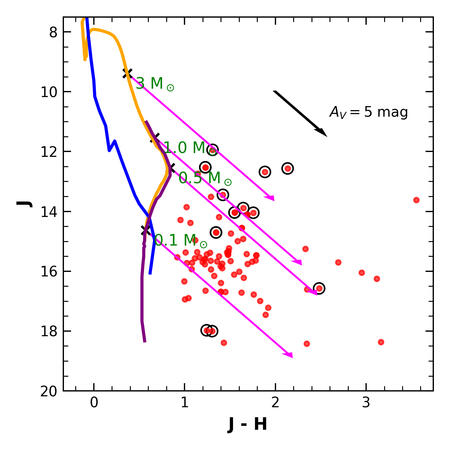
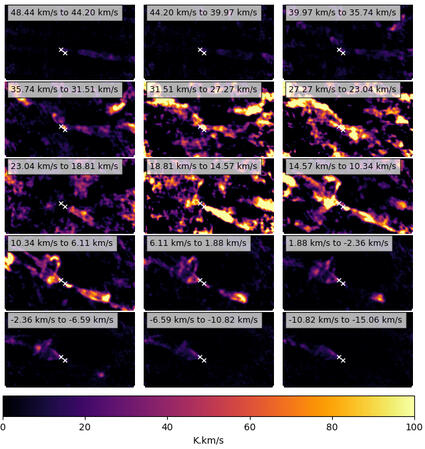
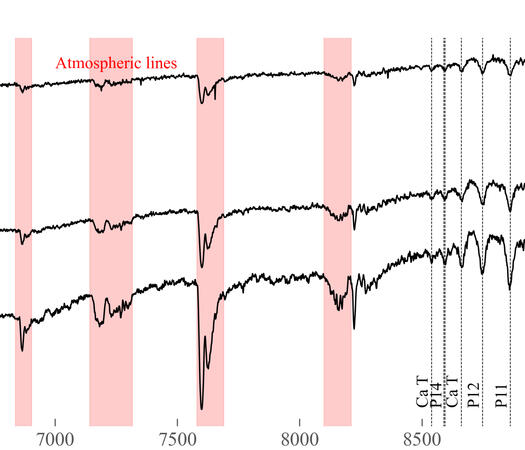
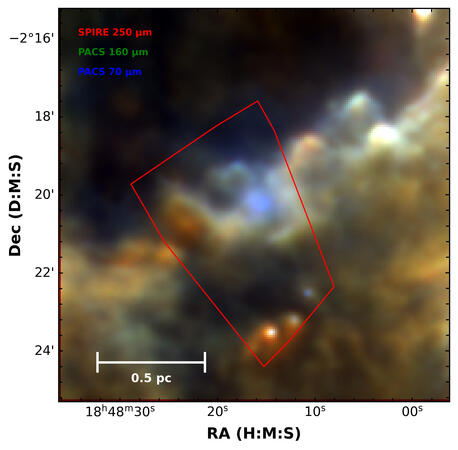
a few dim stars. In my research, I’ve re-examined this region using Gaia DR3 (now at just 606 pc away) alongside infrared data from 2MASS, UKIDSS, Spitzer, WISE, Herschel, and our own optical spectra from IAO HCT under Dr. U.S. Kamath. We found 89 young stars—nine still in their protostellar cocoons and eighty with dusty disks—grouped into tight clumps about 0.5 pc across. Optical spectra of three bright sources near the flaring star show them to be A-K type. Comparing the DENIS and 2MASS data of selected YSOs, we find that they show variability. We constructed maps based on Herschel data, which reveal multiple column density peaks (NH2 ∼ 10^22 cm−2) embedded in cold filaments. What really stands out are the clear gaps cutting through the cold (10–13 K) filaments: empty lanes where gravity and young stars have cleared out gas and dust. These gaps show how pockets of emptiness shape where and how new stars form, offering a simple but powerful view of cluster evolution. The study is finalized and is now in review for journal publication.
4. Deep Learning in Galaxy Morphology and Classification
January - April, 2024
IISER ThiruvananthapuramTo address problems in astronomy efficiently, I familiarized myself with machine learning principles and novel deep learning algorithms. Through my minor thesis in data science under the supervision of Dr. Saptarishi Bej, I classified EFIGI photometry images into their morphological classes using computer vision methods such as Convolutional Neural Networks (CNN). Despite facing challenges such as model biasness and overfitting, we tried out a novel Model Agnostic Meta Learning model in classiying galaxies, which opened doors to few-shot learning in astronomy.
BLOGS

Is there a Black Hole in Barnard 68?

How does a Star Form?


GALLERY

CONTACT INFORMATION
Nilesh Pandey
[email protected]
+91 6395859695Some Useful Links:1. Stellar Spectroscopy Course
2. PyTorch - course
3. Simbad
Images Credit
1. Credit: NSF–DOE Vera C. Rubin Observatory
2. Credit: ESA/Hubble & NASA
3. Credit: NASA/ESA and the Hubble Heritage Team (AURA/STScI/HEIC)
4. Credit: ESA/Webb, NASA, CSA, T. Ray
5. Credit: NASA, Holland Ford (JHU), the ACS Science Team and ESA